



TL;DR
From Auckland to New Orleans, the world greets 2026 with fireworks, mourning, heavy security and scaled-back events after a year marked by tragedy.
Why This Matters
New Year’s Eve remains one of the clearest snapshots of the global mood. As 2026 arrives, celebrations from the South Pacific to the United States blend joy with grief, security concerns and geopolitical tension.
Major cities like Auckland and Sydney still lean on fireworks and public gatherings to mark the passage of time, but do so in the shadow of recent terror attacks. Elsewhere in Asia, countries such as Indonesia and Hong Kong have cut back or reshaped festivities following deadly natural disasters and fires, underscoring how local crises can reshape global traditions.
At the same time, political messages are woven into the moment. China’s leadership is using the high-profile New Year’s address to highlight technological progress and restate its claims over Taiwan, while U.S. authorities are reinforcing security around mass events after recent attacks on crowds. For readers, the latest update on how the world rings in 2026 offers a real-time look at how communities balance resilience and remembrance amid ongoing risks.
Key Facts & Quotes
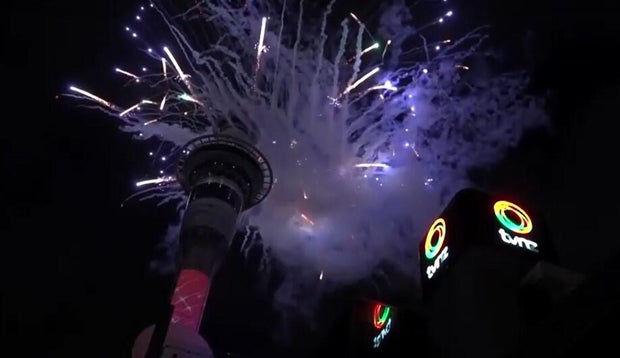
New Zealand was among the first to welcome 2026, with thousands gathering in Auckland despite rain to watch a five-minute display of about 3,500 fireworks launched from the 787-foot Sky Tower, the country’s tallest structure. Some smaller community events on the North Island were canceled because of poor weather forecasts, local authorities said.
🇳🇿✨ New Zealand welcomed 2026 with a spectacular fireworks display!
Auckland’s iconic Sky Tower lit up the sky as one of the first major cities to ring in the New Year.
The Chatham Islands entered 2026 even earlier, leading global celebrations.#NewYear2026 #NewZealand pic.twitter.com/6VVrCOJ9AL
— Newspost.pk (@thenewspostpk) December 31, 2025
Australia’s east coast followed two hours later. In Sydney, celebrations unfolded under tight security after what officials have described as the country’s worst mass shooting in nearly 30 years: a Dec. 14 attack on a Hanukkah celebration at Bondi Beach that killed 15 people and was labeled by authorities as an ISIS-inspired, antisemitic terror attack. More than 2,500 officers were deployed around the harbor, many openly carrying automatic rifles, as crowds filled the waterfront for fireworks over the Sydney Harbour Bridge. A minute of silence was held before midnight, and a menorah image was projected onto the bridge’s pylons while people were invited to shine their phone lights in solidarity with Australia’s Jewish community.


Across the region, several countries scaled back festivities in response to recent disasters. In Indonesia, where catastrophic floods and landslides on Sumatra a month earlier killed more than 1,100 people, the capital Jakarta opted for subdued events focused on prayers for victims, according to city officials. Fireworks and concerts on the tourist island of Bali were canceled and replaced with a cultural arts program featuring dozens of traditional dance groups.
Hong Kong also pared back its usual pyrotechnic show over Victoria Harbour after a massive November apartment fire killed at least 161 people. Instead, the city’s tourism board organized a music event in the Central business district, with landmark buildings turning their facades into giant countdown clocks for a three-minute midnight light show.

Many places marked the New Year with long-standing rituals. In Japan, crowds were expected at a Buddhist temple in Tokyo to hear a midnight bell, while Seoul planned a bell-tolling and countdown ceremony at the historic Bosingak Pavilion.
In a New Year’s Eve address carried by state media, Chinese President Xi Jinping praised his country’s progress in areas such as artificial intelligence and semiconductors while reiterating Beijing’s stance on Taiwan, which it claims as its own territory. “We Chinese on both sides of the Taiwan Strait share a bond of blood and kinship,” he said, adding that “the reunification of our motherland, a trend of the times, is unstoppable.” The remarks came as China’s military announced the end of large-scale drills around Taiwan that the island’s authorities condemned as highly provocative.
In the United States, preparations continued while much of the country was still waking up. New Orleans, the site of a New Year’s Day terror attack one year ago that left 14 people dead on Bourbon Street, is under a heavy security presence. A National Guard deployment authorized by President Trump began earlier in the week. A local official, Minns, told reporters, “We can’t be in a situation where this horrible, criminal, terrorist event changes the way we live in our beautiful city. We have to show defiance in the face of this terrible crime and say that we’re not going to be cowered by this kind of terrorism.”
What It Means for You
For many Americans, this New Year highlights how global news and local life increasingly intersect. Travelers and residents in major cities can expect visible security, from extra police and military patrols to stricter crowd controls, especially at large public gatherings. Those planning trips to popular destinations in Asia and the Pacific may also see more subdued celebrations or cultural programs replacing traditional fireworks.
Beyond safety, the mix of mourning and celebration may feel familiar in a year marked by conflict, disasters and political tension. The way cities from Auckland to New Orleans balance remembrance with festivity offers a reminder of how communities adapt after tragedy. As 2026 begins, it is worth watching how leaders use high-profile moments like New Year’s addresses to signal priorities on technology, security and regional disputes – and how ordinary people continue to gather, reflect and look ahead despite uncertainty.
Sources: Official statements and briefings by local authorities and national leaders; event and casualty details from regional government updates and local media reports as of Dec. 31, 2025.
Question for readers: How do you think public New Year’s celebrations should balance security, remembrance and the desire for open, joyful gatherings?