



Why This Matters
Escalating protests outside Delaney Hall, an immigration detention center in Newark, New Jersey, have led to more than 80 arrests and allegations of excessive force by authorities. The confrontations have turned a local standoff into a national window on how the United States detains immigrants.
The dispute centers on sharply conflicting accounts of conditions inside the 1,000-bed facility and of the government’s response. Detainees and advocates describe hunger strikes, unsafe food, and inadequate medical care, while federal officials and the private company that runs Delaney Hall insist the allegations are false and politically driven.
The situation also tests the limits of state and local power over federal detention operations. New Jersey’s governor, attorney general, and Newark’s mayor have all stepped in, raising broader questions about oversight of private prison contractors and the role of local officials when federal actions spark unrest.
Key Facts and Quotes
Delaney Hall is owned and operated by GEO Group, a major private prison contractor that runs immigration detention facilities around the country, according to reporting from PBS NewsHour and the Associated Press. Demonstrations outside began in late May, with protesters saying they were acting in solidarity with detainees who launched a hunger strike over living conditions.
Advocacy group Cosecha says detainees issued handwritten letters describing moldy and expired food, some allegedly containing maggots, overcrowded cells without air conditioning, and detainees being denied needed medications. Democratic members of Congress from nearby New York City visited the site early in the protests and later said the detainees’ accounts were credible, according to the same reporting.
President Donald Trump and his administration have rejected those claims, denying there is any hunger strike, abuse, or substandard care inside Delaney Hall. Tom Homan, the president’s border adviser, praised the facility’s food after a visit, reportedly telling one outlet that the spaghetti he ate there was good. GEO Group has called the criticism a politically motivated effort to dismantle federal immigration detention by targeting its contractors.
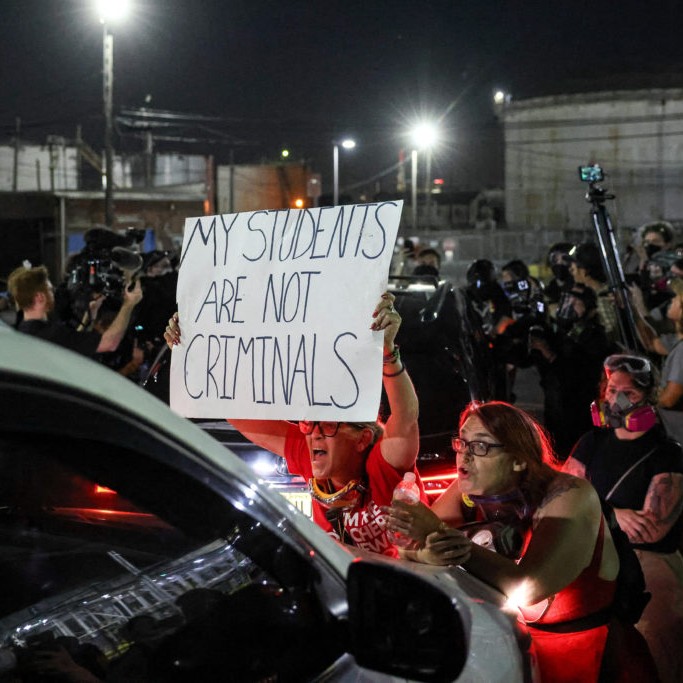
Outside the facility, protests have grown more confrontational. Some demonstrators, wearing gas masks and helmets, used traffic cones and other objects as shields and tried to block vehicles from entering or leaving, according to officials. Videos on social media show officers in riot gear using tear gas, batons, and police on horseback to disperse crowds. Homeland Security Secretary Markwayne Mullin said four people were arrested Friday night on federal charges including assaulting officers and obstruction, while Newark police said a man from Seattle was charged with criminal mischief for smashing car windows. Newark Public Safety Director Emanuel Miranda wrote online, “No one has the right to come into our city, destroy personal property, or incite violence … Think twice before coming to Newark with any other agenda than to protest peacefully.”
Authorities say one law enforcement officer has been charged with stealing roughly $10,000 in camera equipment belonging to Associated Press photojournalist Angelina Katsanis, who was injured while covering the standoff. The state’s attorney general said she used a tracking device to trace the missing gear to the officer’s home.
What It Means for You
New Jersey leaders have reshaped how the protests are being managed. Democratic Gov. Mikie Sherrill called in state police, who set up vehicle checkpoints and designated protest zones as federal immigration officers pulled back from the front of the facility. Newark Mayor Ras Baraka imposed a 9 p.m. curfew, then later scaled back the city’s police presence, citing falling arrest numbers and concern about spending local tax dollars to guard a private facility.
Separately, the New Jersey attorney general has filed a lawsuit accusing GEO Group of blocking state health inspectors from fully investigating the detainees’ complaints. How that case unfolds could affect oversight of other privately run immigration centers and shape how states respond when federal detention policies collide with local concerns about safety, spending, and civil liberties.
How do you think communities and officials should balance public safety, free protest, and oversight when tensions flare around immigration detention centers?
Sources
PBS NewsHour / Associated Press report by Philip Marcelo on protests and arrests outside Delaney Hall in Newark, published June 6, 2026; statements and social media posts described in that report from federal officials including President Donald Trump, Homeland Security Secretary Markwayne Mullin, Acting U.S. Attorney General Todd Blanche, and border adviser Tom Homan; comments and actions described in that report from New Jersey Gov. Mikie Sherrill, Newark Mayor Ras Baraka, Newark Public Safety Director Emanuel Miranda, immigrant advocacy group Cosecha, GEO Group, Democratic members of Congress, and the New Jersey Attorney General’s Office.