



TL;DR
French officers have carried out their first on-water interception of a suspected migrant “taxi-boat” heading toward the English Channel, testing a new UK-France policy to curb small boat crossings to Britain.
Why This Matters
The latest update in the long-running Channel migration issue marks a shift in how France and the United Kingdom try to control small boat crossings. Until now, French police mainly acted on beaches, seizing dinghies and equipment before they could be launched. Interventions on the water were avoided because of the risk to life and legal concerns if migrants were hurt or killed.
The new approach, agreed at a UK summit in July 2025 between French President Emmanuel Macron and UK Prime Minister Sir Keir Starmer, allows French officers to target so-called “taxi-boats” earlier in their journey. These inflatable boats, used by smuggling networks, move along canals or the coast to pick up groups of migrants already in the water, a method French official documents say had an 81% success rate in 2025.
For governments in both countries, small boat crossings are now a top story in migration and border policy. The UK has faced domestic pressure to reduce arrivals and show that cooperation with France can produce results. France, for its part, balances security concerns, humanitarian obligations at sea, and political sensitivities around policing migration routes on its northern coast.
Key Facts & Quotes
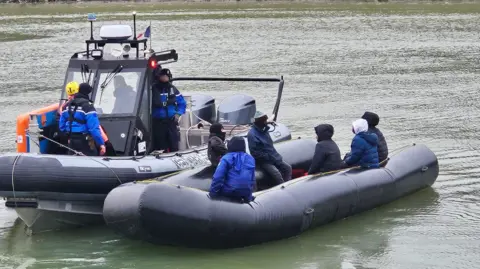
According to a report by the BBC, French officers on Saturday boarded an inflatable “taxi-boat” on the Aa canal in Gravelines, a town on the Channel coast just north of Calais. A police launch drew alongside the dinghy, and a photograph obtained by the BBC shows several men on the inflatable as it is towed back toward the dock.
French officials suspect the vessel was preparing to travel toward the sea to pick up migrants for an illegal crossing to the UK. The BBC report describes the men on board as apparently linked to people-smuggling networks. French authorities have been approached for official comment but had not responded at the time of publication.
The operation follows a change of tactics agreed in November under a broader UK-France deal reached in July 2025. Before this, French police intervened mainly on beaches, blocking boats as they were prepared for launch. On-water action was seen as too risky and raised worries about criminal liability for officers if migrants died during an interception.
Under the new terms of engagement, French gendarmes will only move against “taxi-boats” before they have taken migrants on board, not when vessels are already heavily loaded. Saturday’s interception appears to have followed that rule: police reportedly acted as the inflatable moved down the canal toward the Channel, believing it was about to begin picking up people. The BBC, citing official French documents, reports that the “taxi-boat” tactic had been particularly effective for smugglers in 2025.
The same documents, as reported by the BBC, state that 41,472 migrants reached the UK from France in 2025, up from 36,566 in 2024 but still below a peak of 45,774 in 2022. Earlier UK government data for 2022 recorded a similar surge in small boat arrivals across the English Channel, highlighting the scale of the challenge both countries face.
What It Means for You
For readers in the UK and beyond, this first interception is a signal that Channel migration policy is shifting again. If France regularly boards “taxi-boats” before they collect migrants, crossings may become harder and routes could change, affecting coastal communities from northern France to southeast England.
The move also raises questions about safety at sea and legal responsibility when operations take place on the water rather than onshore. Humanitarian groups are likely to watch closely for any impact on drownings or rescue efforts, while politicians in London and Paris will look for evidence that tougher tactics actually cut numbers.
In everyday terms, the story feeds into wider debates on how countries manage irregular migration, share responsibility with neighbours, and balance border control with protection for people making dangerous journeys. What happens next in the Channel could influence how other coastal states respond to similar pressures.
Sources
Primary details from BBC report “France makes first interception targeting small boat crossings to UK,” by Hugh Schofield, published January 20, 2026. Background on small boat crossings and previous UK-France cooperation from official UK government migration statistics releases (up to 2023) and public statements by the French Interior Ministry on Channel patrol funding and joint operations.
What Do You Think?
How do you think countries should balance tougher border enforcement with safety and humanitarian obligations for people attempting dangerous sea crossings?